

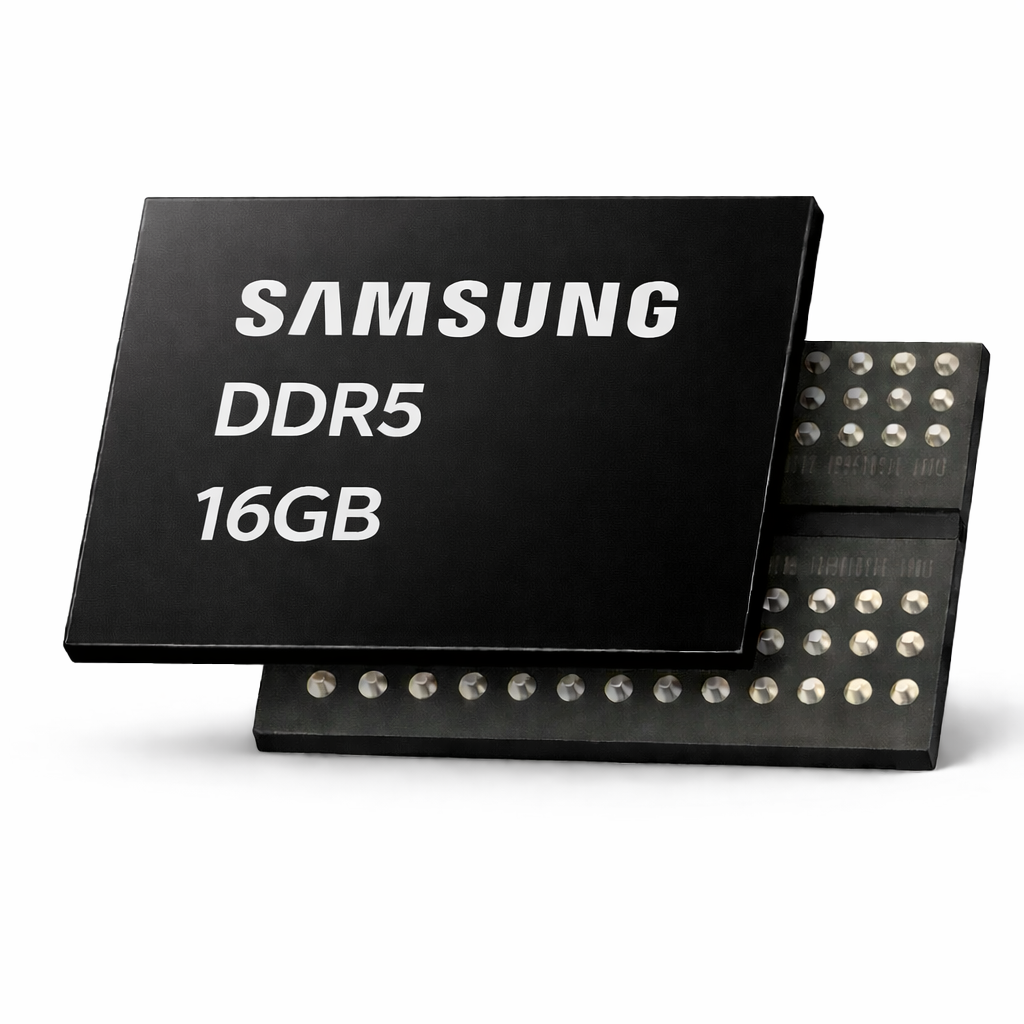
Samsung DDR5 16Gb SDRAM – 4800 Mbps
Samsung DDR5 16Gb SDRAM – 4800 Mbps
Samsung DDR5 16Gb SDRAM – 4800 Mbps
Next-Generation DDR5 Memory for High-Bandwidth, Data-Intensive Platforms
Samsung DDR5 16Gb devices introduce a new level of bandwidth, capacity scalability and energy efficiency for modern computing systems. With a base speed of 4800 Mbps and architectural improvements over DDR4, this series is designed to support data-intensive workloads, next-generation processors and high-performance platforms.
For customers sourcing Samsung DDR5 16Gb 4800 memory chip, planning migration from DDR4 to DDR5 platforms, or qualifying 1.1V DDR5 SDRAM with on-die ECC for advanced systems, this series delivers enhanced throughput and long-term platform alignment.
Architecture & Technical Characteristics
- Density: 16Gb
- Memory Type: DDR5 SDRAM
- Speed grade: 4800 Mbps
- Operating voltage: 1.1V
- Bank structure: 32 banks (double DDR4’s 16 banks)
- Burst length: 16 (double DDR4’s burst length of 8)
- Dual 32-bit subchannels for improved efficiency
- On-Die ECC (ODECC) for enhanced reliability
- On-DIMM PMIC for improved power regulation
Performance Evolution
DDR5 significantly increases memory bandwidth compared with DDR4, improving large data set processing and reducing bottlenecks in high-load environments. With doubled bank count and extended burst length, DDR5 improves parallelism and efficiency in real-time computing scenarios.
- Base transfer rate: 4800 Mbps
- Data transfer rate: 38.4 GB/s
- Improved scalability for AI, virtualization and 8K workloads
- Designed for next-generation CPUs and chipsets
Power Efficiency & Reliability
Operating at 1.1V, DDR5 reduces power consumption compared to DDR4 (1.2V), supporting improved energy efficiency and lower thermal output. ODECC technology helps mitigate single-bit errors at the die level, improving signal integrity and system stability under demanding workloads.
- Up to 30% greater power efficiency versus DDR4
- Integrated on-die error correction
- Enhanced power management via PMIC
Part Number List – Samsung DDR5 16Gb Series
| Part Number | Density | Memory Type |
|---|---|---|
| K4RAH086VB-BCQK | 16Gb | DDR5 |
| K4RAH165VB-BCQ | 16Gb | DDR5 |
FAQ – Engineering, Application & Procurement Perspective
1. What design considerations are required when migrating from DDR4 to DDR5?
DDR5 introduces architectural changes including dual subchannels, increased bank count and on-DIMM PMIC integration. Engineers must verify motherboard layout compatibility, controller support and BIOS configuration. DDR5 is not backward compatible with DDR4 slots.
2. How does ODECC improve system-level reliability?
On-Die ECC (ODECC) corrects single-bit errors within the DRAM die before data is transmitted externally. While not equivalent to system-level ECC, it enhances signal robustness and reduces silent error risk in high-density memory configurations.
3. From a procurement perspective, why adopt DDR5 4800 now?
DDR5 aligns with the latest CPU generations and provides higher bandwidth headroom for future workloads. Early qualification reduces redesign cycles and ensures compatibility with next-generation platforms while improving long-term lifecycle planning.
Share
Request Stock & Pricing
Send the required quantity, target price and destination. We will reply with availability, lead time and quotation details.
